I specialize in STRATEGIC MARKETING, brand MANAGEMENT, Web Marketing,
SEO, Web Design, REVENUE MANAGEMENT for hotels. I offer consulting and
services; I create showcase websites, hotel websites and e-commerce for SMEs, custom
applications
(ERP, CRM, MIS) for Business Management.
MARKETING FOR SMEs
I offer a practical approach that ranges from consulting to
the implementation of the Marketing Plan. My goal is to help companies take the best path, one that
maximizes
profits or minimizes costs. Therefore, before talking about ADVERTISING, we will talk about OPPORTUNITIES,
ECONOMIC FEASIBILITY, and SCALABILITY. Do you want to realize an idea? Together we will try to turn it into
numbers. Do you already have an established business that you want to expand? We will start from current
numbers to understand the best operational marketing actions. This is also the path to take when you simply
want to create a showcase website for your company. A website, before being a Web Design job, is an
operational marketing project with specific objectives and costs.
REVENUE MANAGEMENT FOR HOTELS
16 years of experience, first as a receptionist then as a
hotel manager, have led me to develop a simple and rigorous method for managing COSTS, sales channels,
DYNAMIC PRICING, and short and long-term growth objectives. I propose a PRICING MANAGEMENT method based on
HISTORICAL DATA, ADR, BENCHMARKING, analysis of demand SENSITIVITY in relation to SEASONALITY and BOOKING
WINDOW.
"There is nothing more practical than a good theory" Before viewing my service offering, take a look at this page to understand my Method.
MARKETING FOR SMEs: MIS (Marketing Information
System)
Managing a company's Marketing does not only mean dealing with the promotion of
products or services, but requires addressing different aspects ranging from studying the ability of
one's products to satisfy a specific market to psychological and semiotic analysis of the target,
including economic feasibility. To navigate such a complex process, a scientific method must be adopted
that allows directing MARKETING actions and MEASURING their return on investment (ROI).
Thanks to the MIS (Marketing Information System) it is possible to record and analyze
both QUANTITATIVE and QUALITATIVE variables: profitability of individual products/services;
channel profitability; competitor data (Benchmarking); online presence and sales KPIs; information on
Brand Reputation; qualitative and quantitative information on individual channels and customers. The MIS
serves to:
Record data
Analyze data
Create Indicators
The MIS can be created with one or more SPREADSHEETS (or with custom software) created
ad-hoc for the company; every company and every business is different.
MARKETING INFORMATION SYSTEM APPLICATIONS
E-commerce, which products to include?
I have a physical store and want to create an e-commerce site -
which
products
that I sell in the store should I offer online? Usually the answer is "all of them"! But this for
reasons of
feasibility is not always possible and the choice becomes a big problem. How to solve it? (this is
just
one of the possible methods) Go to your management system, take the revenue of each product
from the
last 3 years, put it in an Excel column, sort the data putting the product with the highest
revenue on top, now go to Google AdWords Planner (you need an AdWords account to do this) and
put the name of each product in the keyword planning tool (a keyword
is a phrase or single word used by Google users to search for that
product),
do it for as many products as possible (try to do it for all), for each product you will
receive
data on the monthly search volume for each keyword related to that product, add them up and
put the result in the product row next to the revenue column, do it for each
product.
Now create a new column with a formula that multiplies revenue by monthly searches.
Finally
sort the products by their multiplications and you will have a ranking of products to include
in the e-commerce. If the budget is for 100 products, choose the first 100. What did you do? You
created
a MARKETING INFORMATION SYSTEM (MIS) that contains an INDICATOR, this indicator relates
your offline core business to your potential online business. In reality it is necessary
to add other variables such as keyword difficulty, discarding most of the more
difficult ones... and, on the market side, growth and scalability variables such as the frequency of
purchase of the same product... But the example is important to focus on 3 aspects: 1)
Data recording 2) Data analysis 3) Creation of indicators. Every marketing action must
start from these assumptions.
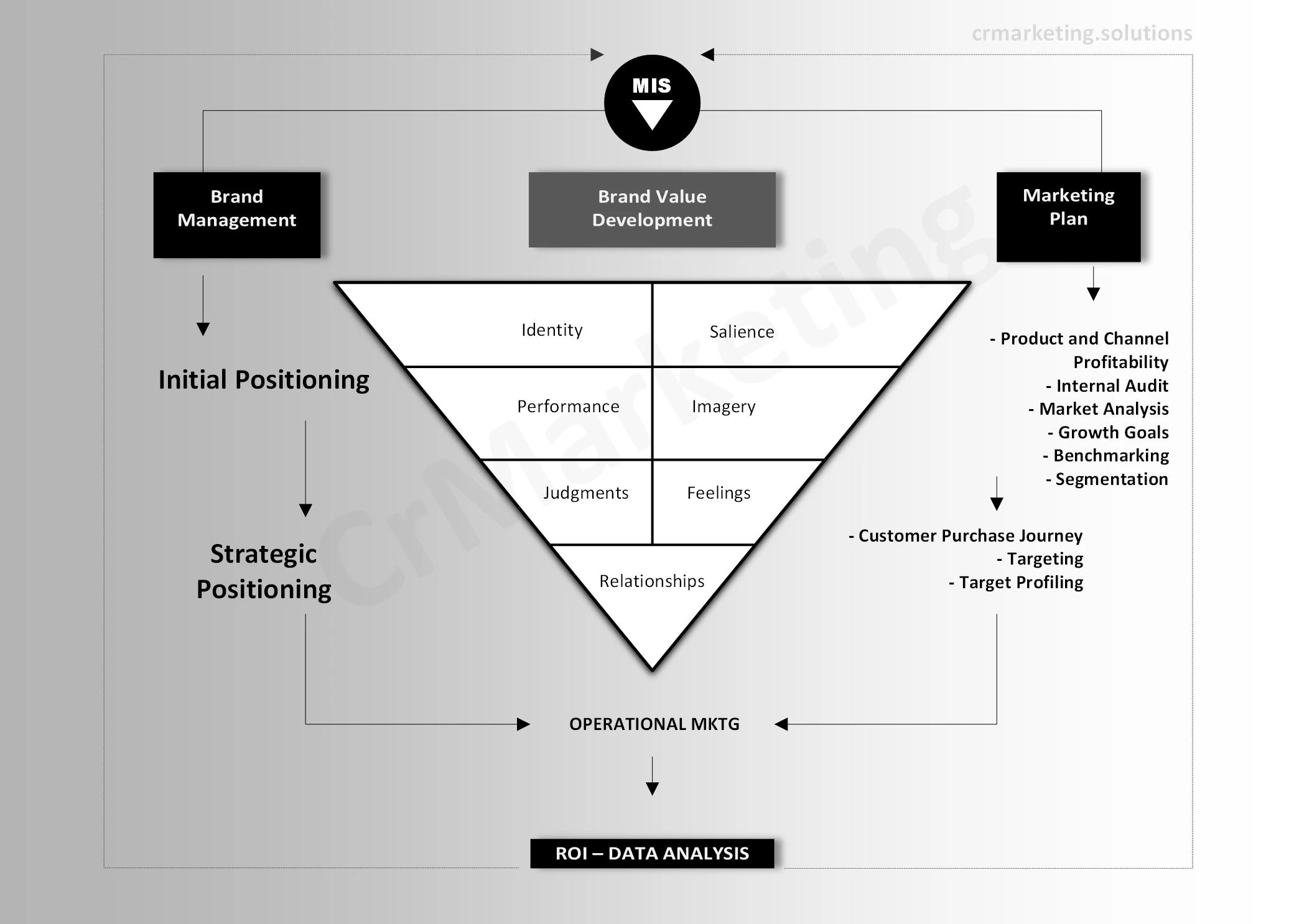
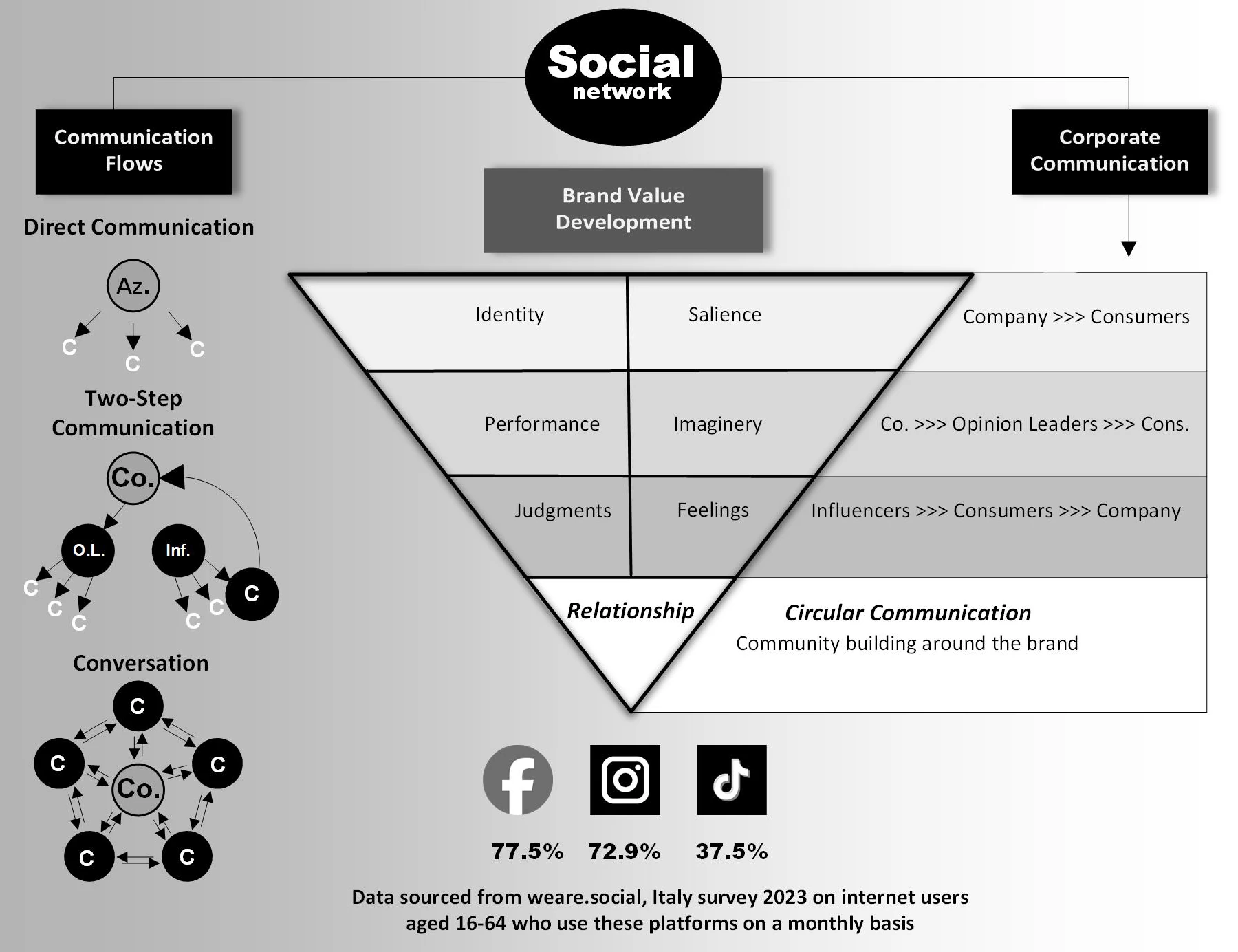
Brand
Value Development and MIS
Alongside strategic marketing, the development
of brand
value (Brand Equity) must be considered. The pyramid you see in the infographic represents the
development
of
brand value according to the cognitivist model:he brand enters the consumer's consideration
through consecutive steps. At the base of the pyramid is brand awareness (you may have heard
about Brand Awarenessè): identity indicates what a brand is and what image it wants to give of itself
to
consumers,hile prominence is how well the brand and its identity are known within the target
market. Without delving too deeply into the parameters that measure Brand Awareness (Recognition,
Recall, Consideration Set...) let's make an example: have you ever accepted an invitation to someone's
home from
a
person you just met? Surely the answer is no, or very few times. You will first
have met that person (and this is anything but a trivial consideration...), then you will have sought
information about them by asking other people; you will have tried to "Google them", you will have
browsed
through
their social profiles. Then you will have met them again with more information and,
after some time, if you liked the person, you became friends. Only after becoming friends,
you established another type of relationship, deeper, which led you to have a clear IMAGE
of your friend... it was a long journey, during which the way of
communicating changed several times: if your friend had been boastful, rude, intrusive at the first
meeting,
would you have
seen them again? NO! But if they had been so at the third, fourth meeting, you would have judged them
with irony
because
you started to ASSOCIATE the other person's image with a VALUE like friendship. Similarly,
the brand must be considered as a person seeking relationships, a person who invites you
to their
home with the goal of having the invitation reciprocated. How can I understand on which step of the
pyramid is my brand? I use MIS data, where I record IMPRESSIONS, CONTACTS,
REVIEWS...
(if I have many reviews it means I have passed the first step) and segment them. How do I use this
information? Let's make an example: I have an international company (but this also applies to a local
company that wants to expand nationally), Italian and English customers know me well (I have
many visits on the site and interactions on social media) while in the United States I have a good
number of followersber of followers
but I'm not very present in Google.Us SERP. Will I distribute the advertising budget
in the same way?
Will the TONE of my messages be the same for all countries? NO. I will probably have to work on the
website, on SEO and run targeted AdWords campaigns for the USA, while for Italy and the United
Kingdom
I will leverage social media more and all my relational networks at my disposal. Communication towards
the
USA will be simple and will aim to get my products into the consideration of consumers with
messages about product quality and performance, while in Italy and the United Kingdom
I can
also try to organize events involving my customers.
MIS and Standard
Indicators
The Marketing Information System is defined as that
"Complex system of resources from which to take the best indications to reduce time, costs and
risks related to decision-making processes", much more practically we can define it as that "place"
where
we build our indicators. If you have good Management Software and perhaps also good CRM software,
you will be able to
easily have information on sales and on each of your customers, and you will have no problems
retrieving
the data as it is already recorded, but to analyze it, and to have important indicators such as
the
ROAS (Return on Advertising Spend) of a campaign or the ACQUISITION COST of a
single customer (CAC), you will have to record all sales and marketing expenses and divide them by the
number of customers acquired in the same time period, which you probably won't be able to do
by tinkering with your management software. You will have to export the data to an Excel sheet or
other software
before processing it. You will have to create a MIS.
Pricing
Management: Dynamic Pricing
Leaving prices unchanged regardless of market DEMAND
is not economical in any sector, and in certain markets it becomes a suicidal strategy.
Some sectors require the need to adopt dynamic pricing, varied frequently, even
several
times a week or even several times a day as in the case of hotels located in major
tourist attractions. The frequency with which prices must be updated is related to the
PERISHABILITY or LIMITATION OF THE PRODUCT/SERVICE, as well as the PURCHASE FREQUENCY, see for
example the food, tourism, events sectors, some categories of products sold
online. Having a MIS, where prices and demand variation are correlated, helps a lot
to
manage them quickly and effectively. Of course you need to know your market well and
the
PRICE SENSITIVITY OF EACH SEGMENT, this is also why it is useful to have a system where
historical sales series are recorded in relation to prices, channels, seasons and other variables
sensitive to your business.
WEB MARKETING: Integrated Strategies
DIGITAL MARKETING represents an important aspect of business promotion, but must be
adopted only after analyzing objectives, product, price and distribution. Online presence
requires integrated strategies that consider both the real market and the semantic one made of symbols and
measurable words. Learn more with our articles on SEO and Social Media.
WEB Marketing
Digital Marketing:
INTRODUCTION
DIGITAL MARKETING does not represent the only way to promote
your own company, for example in the Pension Funds business, public relations are more
effective
than any online advertising.milarly, not all businesses need a website,
see
most bars, and Social Media doesn't work in all markets. You need to get to Operational
Marketing, of which promotion is only one aspect, only after thoroughly analyzing your objectives.
PRODUCT, PRICE AND DISTRIBUTION are the only things that represent VALUE for consumers,
that's why
that's why they come before PROMOTION. Marketing serves to DIFFERENTIATE within a market
saturated with too similar offers, which doesn't mean "showing yourself" in a different way, but
"being"
truly different! That's why a BRAND that tries Online to create an IMAGE different from its
own IDENTITY, won't go very far. Did you know that most e-commerce sites fail
within
2 years of launch? This happens for one main reason: many entrepreneurs believe that online
sales
are easier and with lower management costs than a physical business, some
entrepreneurs even believe that online presence will save them from failed management... but if you
get
PRODUCT, PRICE AND SALES CHANNELS wrong, is it worth wasting money on advertising too? Operational
marketing strategies, like online promotion, should only be a consequence of a MARKETING
PLAN
that identifies them as more profitable than others.
Marketing VS
Web-Marketing
One of the main marketing objectives is
the expansion of one's MARKET SHARE and one of the main MARKET ANALYSIS processes is
SEGMENTATION. In web marketing it's the same, but SEGMENTING THE MARKET, TARGETING AND DEFINING YOUR
OWN BUYER PERSONAS means here first facing another type of MARKET, the
SEMANTIC one,
made of SYMBOLS AND WORDS that, unlike the real world, are MEASURABLE. To expand one's
"real" market share, measurable in terms of sales and revenue, you must first have a face and
a voice within a TOPIC and be present on the first page of search engine SERPs
when a specific keyword is typed. Social Media and search engines like Google are not
just CHANNELS but real markets: the more the number of POSTS, STORIES, VIDEOS, CHARACTERS increases
that can be associated with a specific service or product, and the more searches on
GOOGLE increase
with keywords related to the same service or product, the more the market for that product or service
has expansion potential. At the same time it becomes more difficult and more expensive to enter and
expand your market share, both in terms of revenue and in terms of online
visibility
(market share in the SEMANTIC MARKET).
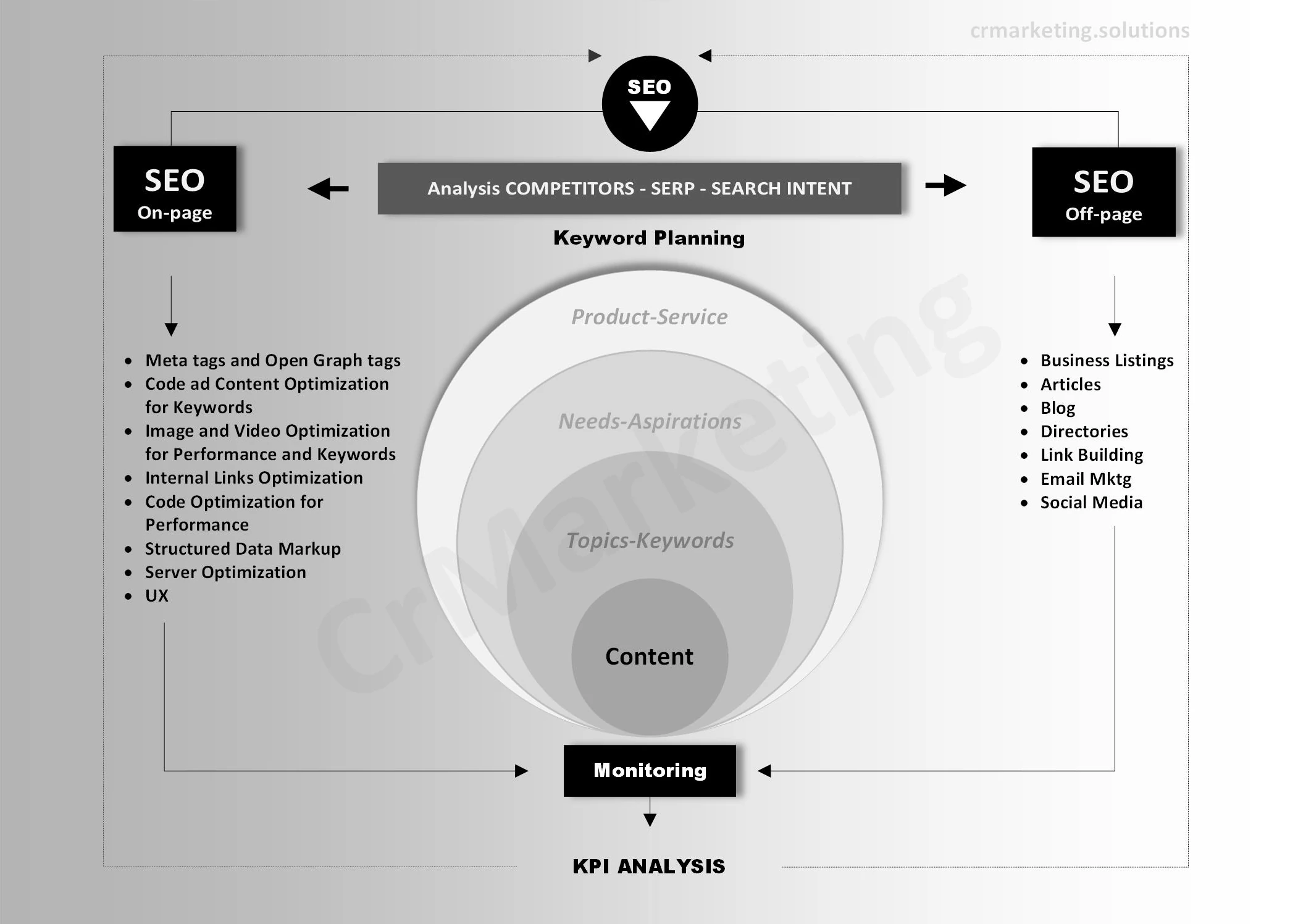
SEO: Search Engine Optimization
SEO (Search Engine Optimization) is a set of practices that help improve a website's ranking
within the search results page (SERP) on search engines like Google.
Off-Page SEO involves building a series of links hosted on external sites and
social media that point back to our site, while On-Page SEO focuses on optimizing
the TEXTS and CODE of the site. SEO is based on the fact that Google always wants to give the best
result to its users who are searching for something motivated by a need that they translate into
a keyword in the search engine (a word or phrase that describes a product, service,
topic, person, etc. For example, "SEO CONSULTANT IN ROME" is a keyword,
as is simply "SEO"). SEO work therefore consists of working on the Texts and
CODE of our site, and on the texts of sites that host links to our site, so that the latter is
recognized by GOOGLE as RELEVANT for certain keywords, those that best match our
products/services and on which we are able to compete. You could even create a beautiful website,
but without SEO it would be like getting dressed up without leaving the house - no one would see you. You
might object: "yes
but there are Social Media! and I'll promote it on Social Media..." but that's not exactly how it works
because, even if
you already have many followers, you must consider that a website is created primarily to ANSWER
SEARCHES MADE BY THOSE WHO DON'T KNOW US and WHO, and this is the real difference with social media,
"ACTIVELY" SEARCH FOR OUR SERVICE OR PRODUCT BY TYPING A KEYWORD. It's true that
"Generation Z" searches directly on social media, and this is important to consider if they are part of
one of our target segments, but almost always the psychological condition of those browsing social media
(often passive scrolling) and those browsing GOOGLE is different, with a much higher level of
psychophysical activation (in
Psychology, State of Arousal) in the latter. Also for this reason, sponsorships
on search engines (advertising on Google) have a significantly higher value (and a higher cost
per single click) compared to social sponsorships. Fortunately, however, there are not only
sponsorships, but you can also be visible thanks to SEO, which is free, except of course for the
fee for those who handle it.
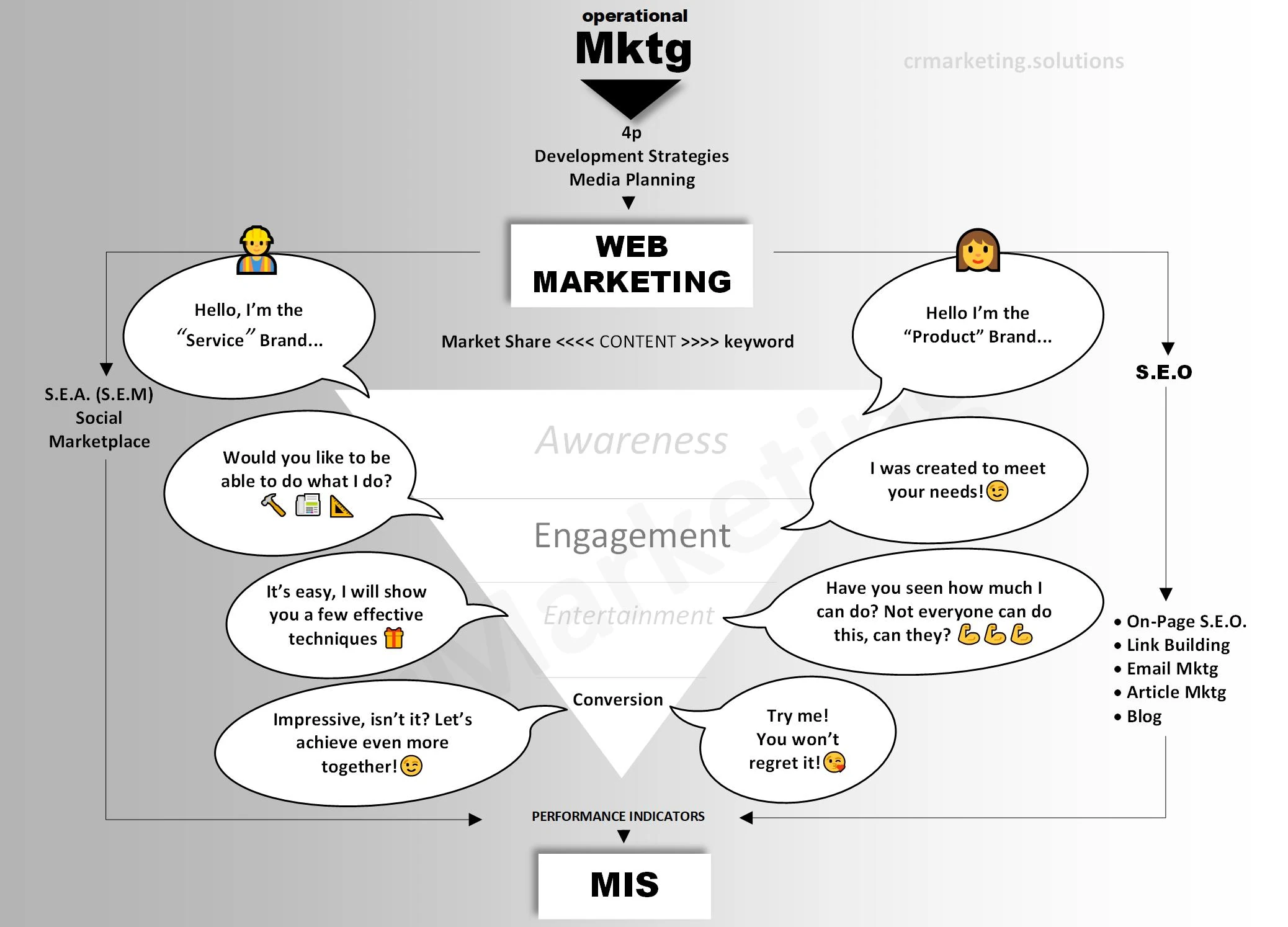
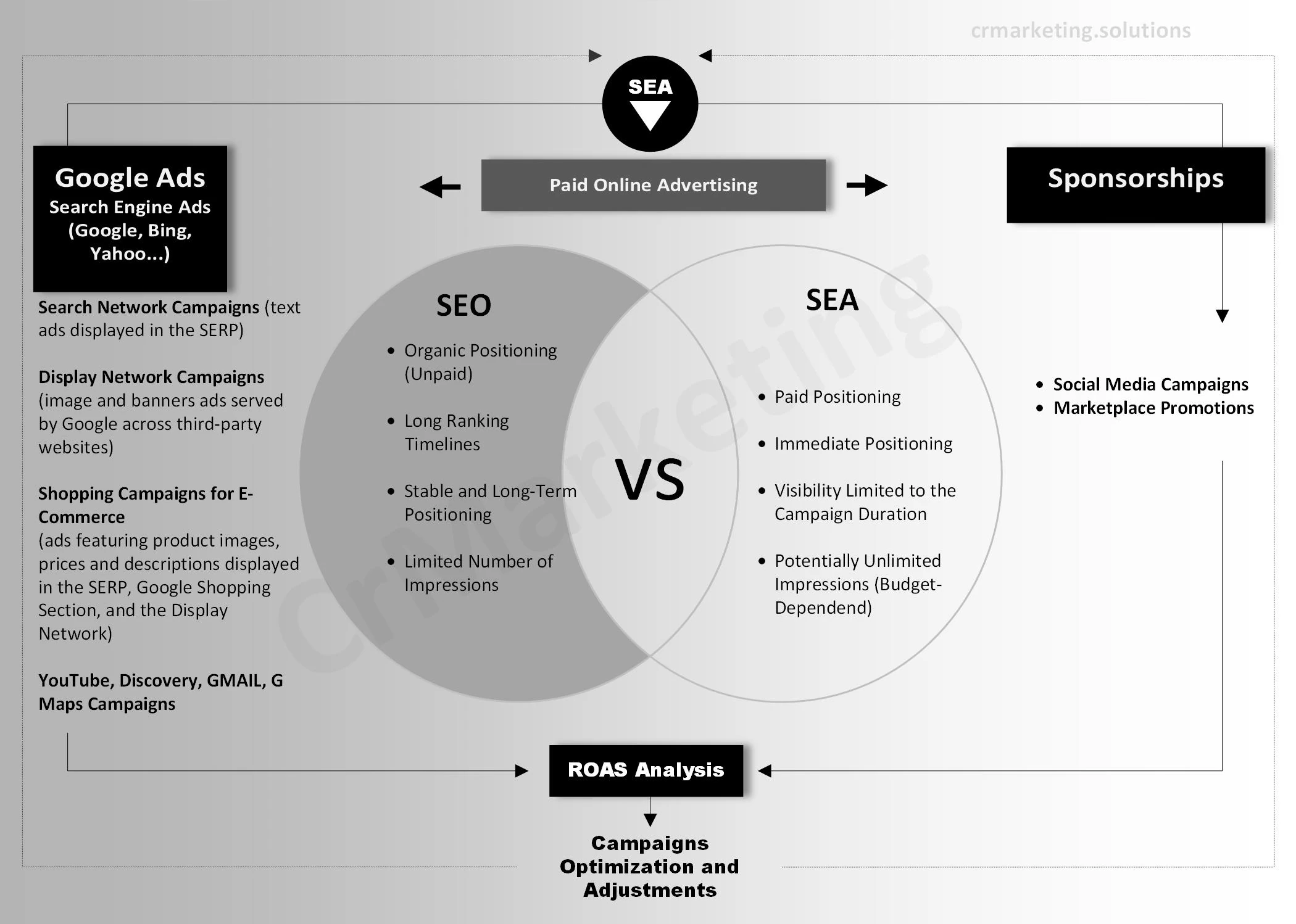
SEA: Search Engine Ads - Advertising
SEA (Search Engine Advertising) is paid advertising on search engines like Google:
you pay so that your products or services are displayed on the search results page and,
depending on the campaign chosen, also in the Google shopping section (for e-commerce), on YouTube,
in emails, on Google Discovery, Google Maps and on other sites that host Google advertising.
Some call it SEM (Search Engine Marketing) while for others SEM includes
SEO and SEA, but much more important than the definitions are the
concepts
(this is why the infographic also includes Social Sponsorships in SEA). I think it's essential
to distinguish two possible types of Online advertising:
Free Advertising done through SEO for the site
and Social content, which is based
on TEXTS (written texts, images, videos) and VIRALITY.
Paid Advertising through sponsorships on search engines like Google
(SEA); Social sponsorships; promotions on marketplaces like Amazon.
Regarding SEA, it's important to know that:
Without investments in paid online advertising, the growth of a brand on the web is
difficult and slow.
E-commerce without investments in paid online advertising face many difficulties because
with SEO alone, and there is a specific one for e-commerce, they cannot withstand the competition.
Paid online advertising is very expensive: for example, a click on a Google
sponsorship can cost on average from 0.60 to 4 euros.
For these reasons, before creating an e-commerce it's advisable to make a Marketing Plan and a
Business Plan
for e-commerce. Those who decide to create an eCommerce must also include the initial
sponsorships in the initial budget.
SOCIAL: Social Networks, Semiotics, Storytelling,
Psychology and Selective Influence
The probability of converting a potential customer into an actual customer during their first encounter
with our product is very low. The "rule of seven" states that seven interactions with
a Brand are necessary before an action is taken. Social Media provide great help in this sense, as
they can oversee the entire "Lead to Close" purchase journey where from the first contact with the
potential
customer (Lead) you get to the sale. Thanks to social media you can help brand recall
by multiplying the exposure of potential buyers to its elements (Colors, Logo, Slogan, People...);
Social Networks are also very useful for communicating the BRAND'S
VALUES; they are essential for getting valuable feedback to improve products and corporate
communication; sometimes they are indispensable for managing RELATIONSHIPS with customers. To
use them best it is important to understand what is behind them and why they work:
Social Networks and Social Media:
our daily life is
marked
by belonging to different groups (family, friends, work, peer groups, groups determined
by the places where we live and groups of people who share our passions). On Social Media these groups
are projected online and companies can, even without being part of them and without knowing them
directly, investigate their ATTITUDES (values, behaviors, thoughts) and adapt their
commercial offer accordingly (Product, Price, Sales Channel, Message, Tone of Communication, etc.).
Social Media also allow us to understand the roles within these groups, where it's important to identify
OPINION LEADERS, people capable of influencing the choices of other people in the
group. On these people are concentrated the greatest communication and persuasion efforts.
Semiotics and Social Media:
the strength of a group lies
in its
ability to
differentiate itself from other groups and belonging to a group is strengthened by the use of certain
DISTINCTIVE SYMBOLS, visual and verbal (Semiological): for example for some groups
wealth represents a value, which is expressed in SYMBOLS such as designer clothes and luxury cars, and
SIGNALS such as the display of an affluent lifestyle. Social Media help companies both to know
SYMBOLS and SIGNALS of their target segments and to COMMUNICATE with them using the
same SYMBOLS AND SIGNALS. This means sharing the same communication CODE, which is essential to be
understood and appreciated. Sometimes however the company, while recognizing in a market segment its own
target, finds itself having SYMBOLS too different from it. In this situation it's useful to use
INFLUENCERS who, already sharing the same communication code with the target, help to
POSITION the company in the latter's consideration.
Storytelling and Social Media:
we've always been telling
ourselves the
same story, in
movies, books, but also at dinner and at the bar, stories always start from a protagonist living a
quiet life (situation of balance), then something happens that breaks the balance, so the
protagonist takes action to restore it with the help of some means and/or people. This pattern
attracts us before the content of the story, because it's recognized by our mind which, in fact,
works through patterns that facilitate our reading of reality. How many times have you watched a
mediocre movie
until the end? I have many times, precisely because I often can't help but follow the "usual" pattern.
In advertising and on social media, thanks to NARRATIVE TEXTS, especially with videos,
you
can activate this mechanism by replacing the means that help the hero with the product or service.
Selective Influence and Social Media:
during the infinite
scroll that is done on social media, when we pause on content even for just a few seconds, we give an
indication of our preferences to the algorithm which records our interest and proposes similar content
to us.
Social media doesn't need to target us, we build our (or
better, our many...) Buyer Personas during the scroll because we continuously tell it things like "I
like this
and that one", I have these VALUES, I follow this political party, I do or would like to do these
things...
the algorithm in response offers us content that suits us without ever going against our
ATTITUDES. We tend to expose ourselves (SELECTIVE EXPOSURE) to messages that
confirm our values, our thoughts and behaviors, because we are "cognitively limited":
we need coherence and balance, and often we don't have enough psychic energy to
evaluate options that don't confirm our ideas. For this reason, the algorithm plays it safe by
continuously reproposing
the same politician, the same sources, the same football team, the same subjects of
study, the same musicians and, nonetheless, the same PRODUCTS. Knowing these things is very important
for a company that must never try to change its identity, its values, its
image, because this would confuse the small minds of us consumers. In any case, it's necessary to
avoid customers entering what is defined in psychology as COGNITIVE DISSONANCE, that
sort of annoyance we feel when someone tries to convince us, or sell us, something that goes
against our attitudes (a set of values, behaviors and thoughts that guide our
actions).
REVENUE MANAGEMENT: Price and Cost
Management
Hotel Revenue Management is a discipline that applies marketing strategies and techniques to the
MANAGEMENT OF HOSPITALITY FACILITIES and focuses primarily on profit maximization: on
CHANNEL AND PRICE MANAGEMENT to optimize revenues and on COST MANAGEMENT. Like any
marketing strategy, it requires a structured Marketing Information
System (MIS). One of the Revenue Manager's main objectives is to achieve
occupancy approaching 100%, with the highest possible RevPAR (Revenue per Available
Room). To achieve this, techniques and tools must be adopted that allow forecasting market trends
(FORECASTING) and varying
room selling prices, seeking to meet demand at the highest possible price, based on: DEMAND variations;
seasonality (studying HISTORICAL SERIES); BOOKING WINDOW (relating
price to the number of days remaining until arrival date); demand SENSITIVITY (in a
given period, at what euro difference does demand respond?); optimizing the price for each
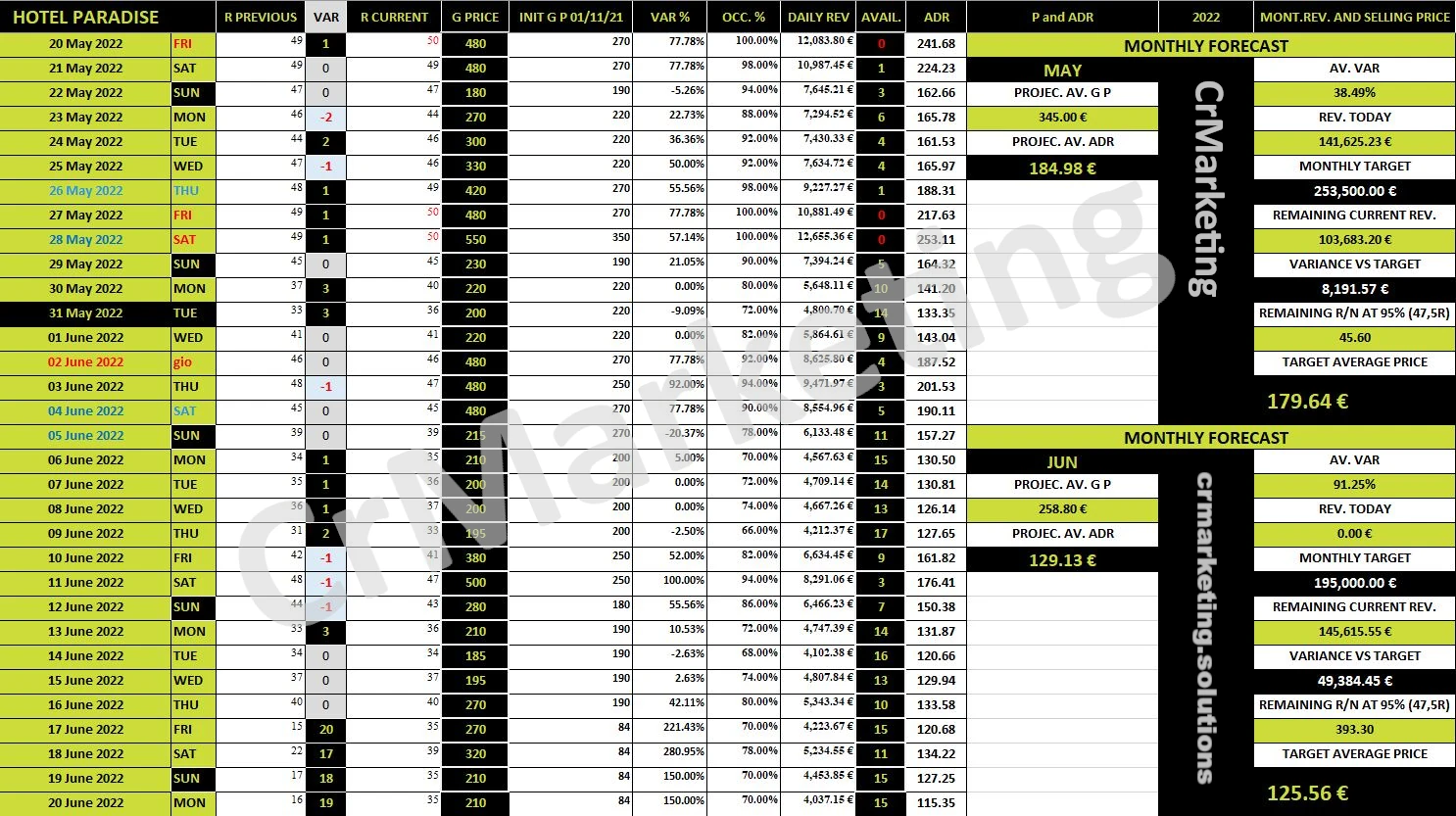
CHANNEL and MARKET SEGMENT. (See below an example of FORECAST IN EXCEL).
DYNAMIC PRICING: an Internal Matter
Dynamic Pricing must be adopted in the tourism sector and in all sectors
characterized by high demand volatility. Frequent and timely price adjustments
help maximize profit both during large tourist flows and in periods of declining
demand. This is possible without sacrificing customer satisfaction because in any case to sell
you must stay within price ranges given by the market. In fact, the Price Range at which to
sell
is determined by the market, which rises and falls based on the law of supply and demand; adopting
dynamic
pricing simply means following its trend. The first rule is therefore to know your own
business (determined by location, category and services offered) and potential (quality and defects)
of your
facility. I am convinced that price management must be done internally both for the
aforementioned rule (no one knows the market better than those who have been working in the same
neighborhood, city and
hotel for years) and because sometimes you need to intervene on prices multiple times a day and this
cannot be
requested from an external consultant. An external consultant however can be hired when there is the
need
to train the hotelier and staff in price management techniques (how to manage the BOOKING WINDOW
according to seasonality, how to identify price SENSITIVITY in your
reference market, how to manage OTAs and other CHANNELS, what software and tools to use
for
dynamic pricing) then it will be them, the company's people, who apply them promptly. Here are
some examples of why price management is and must be an internal process, let's take as
an example
both a 'Human Consultant' and a 'Software Consultant'.
INTERNAL REVENUE MANAGER vs EXTERNAL CONSULTANT
External
"Human" Consultant
- A human consultant updates my prices 2 times a day, at 8.00 in the morning and at 8.00 in the
evening:
in the early afternoon I receive 3 bookings for a total of 5 room-nights (that's a lot if
I have 30 rooms!) for 3 dates, between 40, 41 and 42 days away, for which I had not yet received
anything,
while for dates in the same week I was already at 50% occupancy, which had made me
lower the price for days with low occupancy. After two hours I receive another 5 room-nights
for the same dates. If I intervene by raising the price after the first bookings I could both
increase the
revenue from subsequent bookings and block any other bookings at a price that's too
low. But I don't intervene, because I wait for my external Revenue Manager to handle it when he
arrives
in the evening, too late...
- Second example, same as the first, but let's say the first 5 room-nights come 100%
from a company that periodically sends workers to our Hotel because it does work in the area,
so we know that the sudden demand does not come from tourist flows. We should then, yes raise the
price, but to a lesser extent and monitor the dates, because the increase in demand is not
structural. Does the
external consultant evaluate these things? Does he go through each individual booking to see the
channel of
origin? Does he know the hotel's regular customers well? I don't think he can do it, because if he
does this
work for multiple hotels, he would have to work an infinite number of hours a day!
- Another example: I still have 8 rooms out of 40 to sell for today (and I always want to sell them
all...), so at 8 in the morning the external Revenue Manager lowers the price by 30%, at 8.15
I receive a booking for 3 rooms, I have 5 left. It's 12.00 and there are still 5, it's
14.00 and there are still 5. Do I intervene? No, because I wait for the consultant, at 20.00, to
assess the
situation and perhaps intervene by lowering the price by a further 20%, but the correction arrives
too late and I'm left with 5 empty rooms. This example represents one of the situations
impossible to manage by an external Revenue Manager, because prices often need to be varied
multiple times a day for the same date, and this doesn't only concern last-second, but also distant
dates
that undergo multiple occupancy variations during the day.
External
"Software" Consultant
- Let's say my consultant is a SaaS that is almost omniscient: it follows the entire market by the
second, knows all my competitors, their prices and their occupancy percentage,
knows
all my customers, can even predict tourist flows! But it has a flaw: it doesn't know
how to correlate
the RATING variable with the BOOKING WINDOW variable. It happens then that for my hotel, which for
example has a low rating within a very competitive and little differentiated market, the
software always suggests very low prices even in high season when you reach a booking
window of 30 days because it sees other hotels filling up and not mine. The software doesn't know
that in
high
season you can "resist" maintaining high prices despite few bookings even with a
booking window of only 10 days! And we're talking about Super Software, because most
SaaS don't take these variables into account even separately. But how can I stay
calm if my hotel is half-empty just a few days away? I stay calm if I know my market,
which has been telling me for 15 years, without ever being wrong, not to lower prices for those
dates; I stay
calm if I as a "person" have received 100 phone calls for those dates but didn't want to lower the
price to convert them, I stay calm because I know how to manage price based on my Rating and
because I too, like the software, study the market, in fact I experience it personally by talking to
other
hotels, and I know that all the facilities in my area with a rating higher than mine are almost
fully booked! Being within an undifferentiated market, where the most important levers are
Rating and Price, soon, today, tomorrow or on the last day, customers will have to come to me...
- Another example, still equipped with one of the best software on the market for price management:
for tomorrow I still have 7 rooms (out of 30) to sell and the intelligent software, at 12.00
sharp, lowers my price by 25%. At 12.30 I receive a phone call from a person interested
in 4 rooms for tomorrow, seems like a serious and determined person, who tells me however that they
would
call back within 4 hours to confirm. What do I do? Do I block the rooms? No, because without
confirmation you don't block
anything if it's for tomorrow! The situation for the software doesn't change, it doesn't register
variations and after two
hours, being intelligent, it lowers the price by another 25% allowing the sale of 4 rooms for
tomorrow. I no longer have the 4 rooms that the customer wanted by phone, only 3 remain, but I
sold 4 rooms. Did it go well? Certainly yes, because I sold, even at a low price, more than
50% of the unoccupied rooms, but it could have gone better: we could have waited 4 hours to try to
sell the rooms at a higher price, and then lower it gradually only after the failed conversion
of the phone call.
Forecast Example
COST MANAGEMENT
To manage a hospitality facility, like any company, you must first have an annual
REVENUE OBJECTIVE and an annual COST OBJECTIVE. Working while
always keeping these two objectives well focused, which must correspond to precise numbers, is
fundamental
not so much to achieve them, but to adopt a METHOD to follow with consistency and coherence. To
"Hammer" prices daily and record, and contain, costs daily, you must be guided and
motivated by a final objective. While the profit objective can be changed during the course
of the year, because you cannot foresee all intervening variables, what must remain
constant is the method to achieve it.
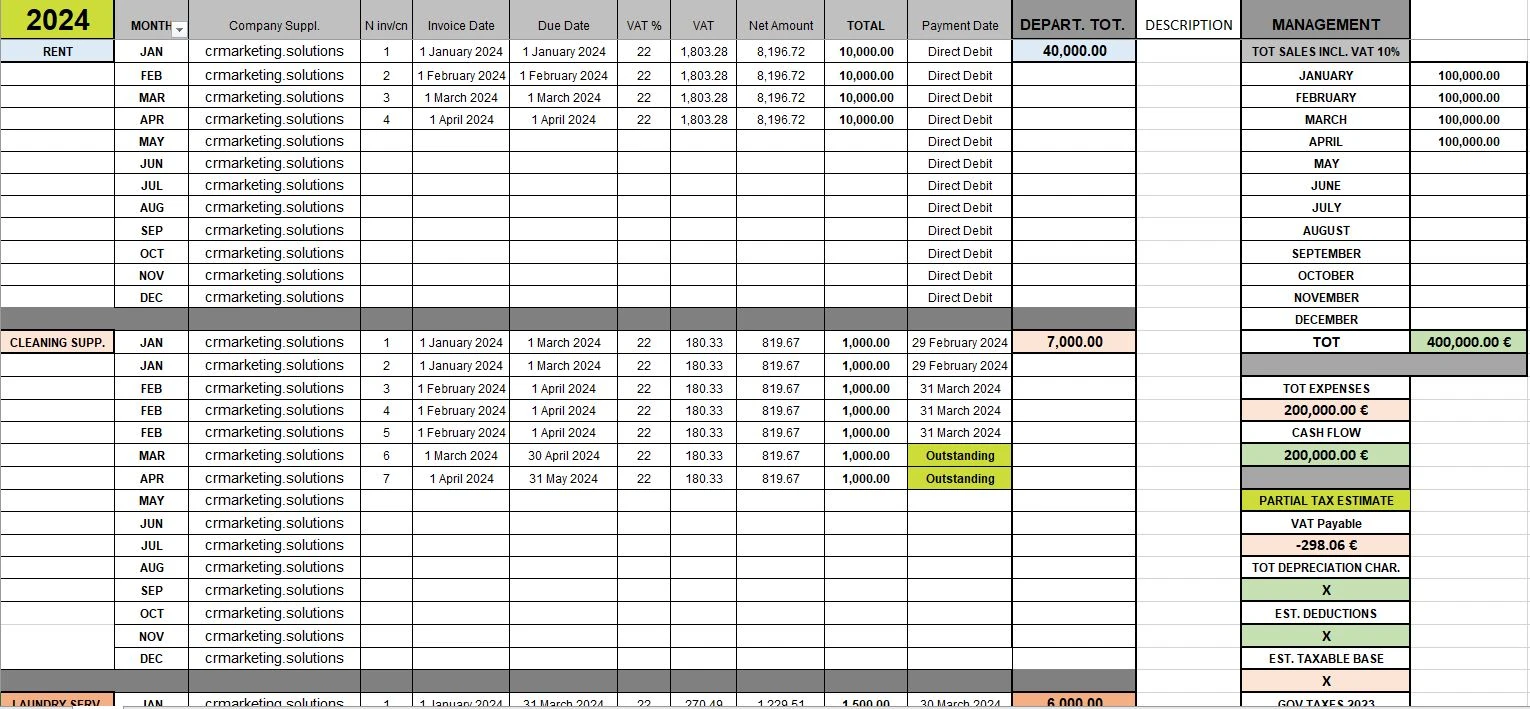
Expense Sheet
Calculating revenue is a very simple thing, calculating costs instead is a fairly
complex thing. In large Hotels, as in all large companies, every expense must be both approved and
accounted for, in small facilities, however, this does not happen and cost management becomes
problematic if a systematic recording method is not adopted. Just as the
FORECAST represents a document to estimate what monthly revenue will be, the
EXPENSE SHEET (created in Excel or with other software) guides us toward profit
estimation,
and it is a document with multiple uses:
Record payments and keep track of deadlines
Classify expenses by department
Calculate Cash Flow daily
Estimate taxes and profit
Have a control tool for the Income Statement made by the accountant
Expense Sheet Example
DISINTERMEDIATION: from a
sustainability perspective.
In recent years in the hotel sector an oligopoly has developed on the distribution side
represented by large OTAs (Online Travel Agencies like Booking.com and Expedia) which has completely
changed the
market. On one hand there are fewer barriers to entry and all hospitality facilities can have
great visibility, on the other hand competition has increased and the game is played on RATING
(therefore on the
facility and service) and on PRICE. This means that you can manage a hospitality facility
delegating almost entirely two fundamental variables of Operational Marketing: DISTRIBUTION and
PROMOTION. Despite this "convenience" the main objective of many hoteliers is to
regain control of these two variables, but at what cost?
THE COSTS OF DISINTERMEDIATION
Managing a client "directly" with the main purposes of building loyalty and reducing commissions
for
OTAs, GDS and Tour Operators, means taking on the costs of Promoting the facility and CUSTOMER
MANAGEMENT (Booking, negotiation, payments, assistance, legal responsibilities); to do this you need
to have highly professional staff (which is increasingly difficult), with greater responsibilities, as
well as
numerically larger. Furthermore, if the main objective is customer loyalty, you must
carefully weigh the advantages and disadvantages that derive from it: if on one hand you invest in
direct promotion to have more margin on room sales, on the other hand you must give up
dynamic pricing, which is difficult to apply to the "regular customer" segment, with the result of not
being able to
fully exploit the benefits due to the large tourist flows that periodically occur (not
only
thanks to seasonality). You must therefore ask yourself which of the two costs, that of intermediation
or that of DISINTERMEDIATION, a given facility can better manage
in terms of profit. Certainly for large facilities, equipped with many rooms (having many and
different rooms available allows you to work on a wider number of target segments) and for
hotels that offer exclusive services such as 5-star hotels, which manage to obtain a PREMIUM
PRICE
due to the quality of their services and the importance of their brand, the best strategy is
customer loyalty, or rather loyal customers and channels represent important market
segments. In other words, hotels with many rooms must ensure an occupancy base
by cultivating relationships with regular customers and agencies, and exclusive hotels can apply
high
prices even to regular customers because for their targets the product/service has more value than
its cost. These hotels also have Know How, Organization and highly professional Staff
capable of managing direct customers in the best way. But for small hotels and B&Bs that play the game
with few rooms and above all offer standard services, which have no potential for
differentiation,
the most important lever to achieve profit is represented by PRICE. Naturally first
you need to
take care of everything that has value for the customer, therefore the facility and service, as well as
optimize
COST MANAGEMENT, but the difference between going into profit or loss is often determined by
optimal price management. Furthermore, maximizing margin on sales with DYNAMIC
PRICING is achieved more easily by delegating the relationship with the customer to agencies because you
deprive them
of negotiating power.
SUSTAINABLE DISINTERMEDIATION:
A way to have SUSTAINABLE DISINTERMEDIATION, which on one hand allows you to exploit dynamic
pricing and on the other hand does not increase internal management burdens and costs is possible by
deploying the
same tools used by OTAs, first and foremost the automated management of facility
promotion and booking. The tools are:
WELL-MAINTAINED AND ALWAYS UPDATED GOOGLE MY BUSINESS LISTING: the hotel listing must
be present in Google's SERP when searching for the hotel's name. In addition, the listing must
appear on GOOGLE MAPS when customers search for a hotel by geolocating the location. The same
applies,
although with less importance (95% vs 5%) for the BING PLACES FOR BUSINESS LISTING.
GOOGLE FREE LISTING: display the official website rates under the Google My
Business listing with the related link to it.
SEO OPTIMIZATION AND HOTEL-SPECIFIC STRUCTURED DATA MARKUP: SEO for
Hotel websites located in major tourist attractions is not very effective because Google's
SERP
is filled with OTA sponsorships and because there is too much competition on keywords in
organic search, but it's always good to maintain it to increase views on the official website. For
hotels located in a less competitive market, however, SEO optimization can give great
results.
WEBSITE WITH INTEGRATED BOOKING ENGINE: a website that allows
a booking experience
equal to that of OTAs, both from mobile and desktop, that clearly contains
all information about the facility and payment and cancellation policies.
CHATBOT: chatbots that leverage AI installed on your website to answer
customer FAQs can represent a good solution to lighten the staff's load from customer requests (and
they
make many!), unfortunately at the current state they are not integrated with Booking Engines and
this
means that an operator must often intervene to respond manually.
These are the low-cost (sustainable) tools that, if well implemented, can help achieve
a high percentage of direct bookings. However, you must know your objectives and your
limits well: for bookings that come from the website, the entire customer management will be the
responsibility of
reception staff.
PPC PROMOTION (Pay Per Click):
Large facilities, which work on many market segments and aim for customer
loyalty, can add, in addition to EMAIL MARKETING, these PAY PER CLICK tools:
GOOGLE ADS: campaigns (ads) on the search network, display network and on YouTube.
Learn more about search engine advertising (SEA).
GOOGLE HOTEL PRICE ADS: to make the hotel's official website appear in the first
results (the sponsored ones) in Google's price comparator and in the Google My
Business listing (Using Google Free Listing instead you appear at the bottom).
METASEARCH: sponsorships on portals like TRIVAGO.
SOCIAL CAMPAIGNS: sponsorships on Social
Media to reach specific targets.
PPC promotion tools are very expensive and can result in costs equal to or higher than
OTA commissions. From the perspective of profit maximization they represent
disintermediation that doesn't make much sense, but if the objectives are to BUILD LOYALTY and SELECT
your clientele, then it's good to use them.
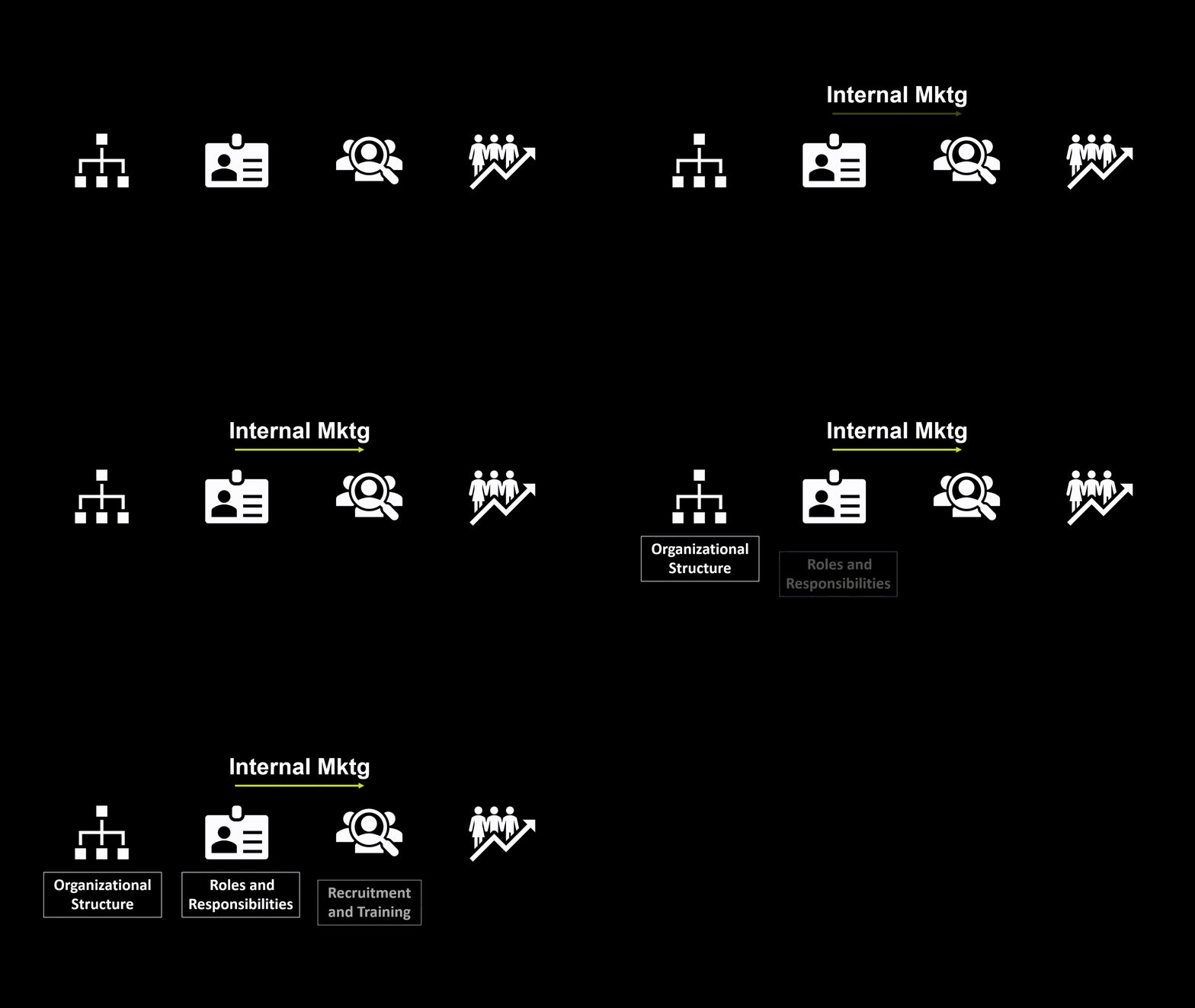
INTERNAL MARKETING, the best way to
achieve a competitive advantage
All companies, and even more so those in a highly competitive market such
as
that of hospitality in large cities, must aim to achieve a Competitive
Advantage (a strong point compared to competitors) based on the ability to
differentiate
from competitors: the main differentiation strategies focus either on having a better
quality/price ratio, or on having exclusive services that focus on specific customer
segments. But there is another way to achieve a competitive advantage: having staff
better than other facilities. Human resource management is an aspect of vital importance:
companies are nothing more than the people who work there, and the value of a company reflects the value
of
its employees and its organization.
BUSINESS ORGANIZATION AND HUMAN RESOURCES
Even small hospitality facilities must have a precise business organization with well-defined
objectives and
processes. This is fundamental to be able to define ROLES AND TASKS that
people will have to perform with a view to WORK STANDARDIZATION. The entrepreneur
must be able to organize the company so that everything works effectively and with minimum
effort: each task must be written in detail so that the worker, the right person
in the right place, can perform it in the best way. Standardizing is not synonymous with limiting, but
means
channeling all the worker's Skills, creativity and energy within the processes useful for
achieving business objectives; moreover following rules in performing one's tasks
lowers the psycho-physical stress deriving from the very fact of working and is the best way to free
personal abilities and creativity. Before SELECTING the person to put in a specific
ROLE you must therefore define it well. This is important especially in these years
where
there is absolute poverty in the labor market in terms of quantity of resources and professionalism,
in fact if you know well and know how to explain well the tasks of those who cover a certain role,
you
will be able to explain them (PROVIDE TRAINING) even to people with little experience. Taking for
granted
the importance of the SELECTION and MOTIVATION process of human resources, I would like to dwell on the
concept of professionalism: many hoteliers think they are the only important person in the company
and
select, or have selected, low-cost employees unsuitable for their role, but instead of
saving they create disasters in organizational terms and especially in profit. This happens
for
all roles, even for directors, but especially for those considered minor such as
waiters. These entrepreneurs don't understand that, even if there are "less important" roles within
an organization, there cannot be less important people. In fact a single "wrong" person
within an organization can bring it to ruin, whatever role they cover. Furthermore, for
each
role there is a need for professionalism, skills and professional and personal competencies (SOFT
SKILLS):
to
clean a room you must have method; know how to use certain products and tools; be able
to respect timelines; be able to work in a team; know how to communicate analytically
maintenance-related problems; know how to manage physical effort, have humility and
empathic abilities in accommodating customer needs and, as for all roles, know how to follow
rules. Not everyone can therefore clean rooms, not everyone can cover any role, the
rule of the RIGHT PERSON, IN THE RIGHT PLACE AND AT THE RIGHT TIME must never be forgotten.